If you find the Primal Potential podcast help, it would mean the world to me if you’d take a minute to leave a rating & review! That helps show platforms display my podcast to new listeners! Thank you so much for your support! I can’t tell you how valuable it is!
I got a fantastic email the other day from one of my Fall Fat Loss Fast Track members. After setting a goal and having a couple good days, she struggled. She didn’t do the work. She had a “bad day”.
On this bad day, she emailed me.
I know one of my biggest issues is eating (and eating too much) when I’m not hungry. I’ve been working on tackling this for years without much success.
I’ve decided my 30-day goal should be around this issue. I want to eat when I’m hungry and stop when I’m satisfied.
Yesterday was great. Today, not so much. I ate well beyond satiety at dinner.
Did I choose the wrong goal? As you say, was my motivation exceeding my skill set? Am I trying to hit this goal every single day or is 80% consistency good enough?
Am I overthinking it because I’ve already stumbled?
I TOTALLY relate to this line of thinking. You get motivated, set a goal, crush the day and then pretty soon…not so much.
How you respond at this point is EVERYTHING. You can tell yourself it’s too much, it’s too hard and you can’t do it. Or, you can change your perspective.
The choices you make on & following your bad days will determine your success & your ability to reach your goals.
Let’s say you decided you wanted to be a great basketball player and you were going to start by improving your free throws. Every day you’re going to practice.
The first day goes your way. You’re sinking all your shots and it feels amazing. You’re encouraged. You feel hopeful.
The next day, you’re off. You’re missing more shots than you’re making. You get frustrated.
Welcome to PRACTICE, the path to improvement. This is what it looks like, folks. This is when it matters most that you keep going.
Here’s the thing: when you have that off day on the court, you learn from it. Is my head in the game? Am I distracted? Is my form off? Are my muscles tired? Am I using different equipment I need to adjust to?
Struggle is where we learn. It’s where our practice improves, it’s how we get better.
The mere decision to create a goal isn’t enough. You can’t expect flawless execution just because you’ve decided on it.
Progress requires practice.
Practice in and of itself is imperfect.
You grow when you evaluate your imperfect practice and learn from it:
What am I doing right?
What am I doing that could be improved?
What’s different from yesterday when things were going so much better?
What can I do differently?
And then, most importantly: KEEP TRYING.
Now, the need for practice isn’t license to not try your best. In fact, the value of your practice depends entirely on your effort.
Every day do your best. Accept that “your best” will often look different from day to day.
Don’t ignore the opportunity in your struggles. There are nuggets of gold in those challenges that, when you learn from them, dramatically accelerate your rate of progress.
So you had a day that wasn’t what you had hoped. Was it better than you’ve done in the past? If so, that’s progress! Congrats! Keep at it!
And even if it’s not, are you practicing? Are you learning? Are you bringing awareness to how it makes you feel so maybe next time overeating doesn’t sound like such a great idea?
So to my sweet Fat Loss Fast Track friend – no, you didn’t set the wrong goal. Welcome to practice, the path to your goals. This is what it looks like. Learn to love it.
Do you find yourself making promises to eat healthy or workout, only to talk yourself out of it hours or days later? I used to do that all the time & it left me feeling frustrated and prevented me from making the progress I wanted desperately!
In today’s episode I want to help you stop breaking promises you’ve made to yourself!
You cannot reach your goals if you are constantly talking yourself out of taking the steps to achieve them. Every choice you make leads you somewhere, either closer to or further from your goals.
To get the details on the challenge I’ve given myself to take 45 yoga classes in 45 days and all I’ve learned from it, click here to listen to episodes 235 and 239.
How to Stop Breaking Promises You Make To Yourself
I’m not super hero. Though I have committed to 45 yoga classes in 45 days, I certainly don’t want to go everyday. Heck, I don’t want to go most days. But, how to battle those feelings? How do you shut down your attempts to make excuses and not do the work you said you would?
Your goals don’t make you a hero. Your intentions don’t create results.
It’s not what you intend that matters – it’s what you do.
It’s not what you do when you’re motivated that counts, it’s what you do when you aren’t motivated that makes all the difference.
Doing the work is the ONLY thing that gets you to your goals.
So, how do you respond when you start talking yourself out of the work?
Don’t use logic to sabotage yourself
The most dangerous thing we can do is to use logic to talk ourselves out of our goals. Sometimes this logic is valid, and sometimes the logic is faulty or a flat out lie.
Either way, you’re talking yourself out of moving towards something you want.
No bueno. That won’t get you there.
So how do we stop breaking our promises? So how do we stop making excuses?
Get brutally honest with yourself and stop justifying quitting.
Don’t let your beautiful brain hold you back
If you allow your mind to consider all the reasons you shouldn’t do the work, you’ll always find plenty of them.
Don’t do that.
Instead, challenge yourself to identify what work you CAN do.
Your brain is there to help you, to become an ally to your goals. Use your brain to talk yourself into your goals and consistency. Use your brain to talk yourself into what you CAN DO.
Do not let the present moment be the only moment you consider
Ask yourself, at the end of the day, what decision will make me the most happy? Don’t make your decisions based on what will make you happy in the present moment, rather, bring your attention to how you’ll feel later.
Step back and ask yourself why you made the promise in the first place. Remember the reasoning behind the decision and understand that your choices now do matter, even the little choices.
Keep your decisions aligned with the logic behind the promises you made to yourself.
Create your foundation first
Your first step needs to be creating a solid foundation. Often times we only focus on the outcome, but without the foundation our efforts can be in vain and we will only increase frustration.
When you skip steps, you find yourself working hard without getting the results you want.
Your foundation needs to be unshakeable before you rush around doing everything.
What CAN You do?
The most important thing is to not quit on yourself.
Find your reasoning for making the promise in the first place. Don’t let excuses, even valid ones, steer you away from your ultimate goals. Use your beautiful brain to keep your body and actions in check!
If you find the Primal Potential podcast help, it would mean the world to me if you’d take a minute to leave a rating & review! That helps show platforms display my podcast to new listeners! Thank you so much for your support! I can’t tell you how valuable it is!
I am SO pumped about today’s Book Club episode! This might be one of my very favorite podcast episodes! Today we’re diving into the book “Why We Get Fat” by Gary Taubes.
In this book you’ll learn what drives insatiable hunger, what decreases satiety, makes us feel tired and unmotivated and what triggers us to store more fat than we should (and burn less fat than we should).
The book is definitely worth the read and Taubes goes deep into both history & science. But don’t worry, if you don’t have the time or desire to go through the whole book, I want to share the highlights with you today!
I really think this episode is a game changer packed with super helpful information about how we can store less fat and burn more fat!
Because this episode goes deep into the science of fat burning and what we can do about it, I’ve decided to limit the show notes to the resources because I think it’s absolutely essential that you listen to the full episode in it’s entirety. I believe it is a game changer. Do NOT skip this episode!
If you find the Primal Potential podcast help, it would mean the world to me if you’d take a minute to leave a rating & review! That helps show platforms display my podcast to new listeners! Thank you so much for your support! I can’t tell you how valuable it is!
If you are looking to take your motivation, consistency or progress to the next level, today’s podcast is full of ways to do just that! If you need help setting expectations that are ambitious enough without setting you up for disappointment or failure, you don’t want to miss this episode!
A huge part of success in any goal is improving your responses to temptation, frustration, setbacks or emotion.
I’ll be sharing lessons I’ve learned in my new yoga practice to help you set appropriate expectations, avoid comparison, build consistency and fast track your results.
As I’ve recently shared on the podcast, after being diagnosed with Hashimoto’s thyroiditis and some stress-related health challenges, I’m making some changes in both my diet & lifestyle to help my body heal.
One of those changes is yoga. I am not a yogi, I do not like group exercise, but I’ve taken on a legitimate mental, physical and logistical challenge:
45 yoga classes in 45 days.
I’ve walked out of every single class so far feeling like I’ve learned something beyond the mat, beyond the yoga pose, and I’m planning to share those lessons with you each week for the next 45 days.
So, I’m two weeks into my yoga challenge and I’ve learned some good stuff!
Always come back to stillness
In life, more often than not, when we experience tension, frustration, emotion, anxiety or temptation, we react, respond and make things worse.
We do the opposite of returning to stillness.
We kick up a frenzy. We panic. We perseverate. We worry.
Instead of saying to ourselves, “Wait, slow down, take a breath, be still, don’t react”, we eat. We distract ourselves with food. We yell. We make snarky comments, we withdraw. We manufacture drama.
We are an instant gratification society and unfortunately that means we feel like every thing must be reacted and it must be reacted to NOW.
This idea of “come right back to stillness” can be a game changer no matter what your goal is.
When you feel rattled, return to stillness. Don’t react. Slow down, be still and understand that often times, the best response is no response.
However, you can’t return to a place you don’t know. If you don’t know what stillness is or where to find it, you can’t go there when you need it most.
You need to practice moments of stillness so you understand where to go instead of reacting. You can practice by meditating, praying, journaling or simply focusing on your breath.
You can practice for 30 seconds or 30 minutes, just practice.
Set expectations based on YOU
It’s easy to set your expectations and standards based on other people. It’s easy to look to someone who is further along than you are and decide that you need to perform at their level.
Don’t.
In yoga, striving to match the practice of someone who is more advanced doesn’t mean that you’re a motivated hero, it means that you’re likely to get hurt and set yourself back.
In fat loss & fitness, setting expectations based on someone who is further along than you are could mean setting yourself to feel not good enough, to feel defeated, overwhelmed and then give up.
Set your standards and expectations based on YOU.
Build consistency to see improvements
The fact that I am practicing yoga every day for 45 days makes it really easy to see my improvements.
Since my last class was just yesterday, when I sit in class today I can easily see what is different and better from the day before.
The daily practice allows me to see my improvements and my progress. If I was going once or twice a week, not only would I probably not make progress as quickly, I wouldn’t recognize as easily.
Both making progress and being able to recognize and observe and notice the progress you make – it’s so motivating! And it drives the desire to continue practice and then you get into what I call the cycle of accelerated returns.
The same is true with consistency in improving your food choices or consistency in your workout routine.
When you are inconsistent, you’re robbing yourself in multiple ways. #1,
You don’t make progress as quickly, of course
You aren’t as aware of progress you do make
If you reject temptation every single day, it’s gets easier and easier and you have a closer comparison to have it felt yesterday to be able to recognize that it’s easier today.
Build consistency. Practice every single day.
Don’t let your ego get in the way of your progress
Oftentimes, after hearing the same message a dozen or more times, a client will excitedly say to me, “I know you’ve said that a million times but I finally get it! It clicked today!”
We have a natural tendency to tune out when we think we know or understand something. We don’t listen with full attention to concepts we’re familiar with.
However, we only retain about 40% of the information we hear (and that’s when we’re giving our full attention!)
Therefore, don’t let your ego get in the way of your progress.
Continue to listen for that one piece you didn’t hear last time that could be the thing you need to move you forward.
I’m really excited about the mental & emotional lessons I’m learning on the mat & I’m excited to keep sharing them with you!
If you find the Primal Potential podcast help, it would mean the world to me if you’d take a minute to leave a rating & review! That helps show platforms display my podcast to new listeners! Thank you so much for your support! I can’t tell you how valuable it is!
Have you ever felt like no one appreciates how hard you work?
Maybe you feel like your kids don’t appreciate all you do for them.
Maybe you feel like your spouse overlooks your daily contributions.
Maybe you think your boss takes you for granted.
If you’re like me, you’ve had many internal dialogues (or full blown meltdowns) about not feeling appreciated, feeling taken advantage of or like your hard work and effort isn’t acknowledged.
It doesn’t feel good, does it? It’s not very sustainable, is it?
At some point, resentment grows and you reach a tipping point, right?
Well let me ask you a question:
Do you appreciate all your body does for you on a daily basis?
Do you acknowledge how hard your body is working to keep you alive?
Are you taking it for granted?
Are you giving your body the care & respect it deserves?
If not, there will come a tipping point.
Your body is ALWAYS working. Its only fuel is that which you give it.
Are you recognizing the magnitude & significance of that responsibility?
Think about it.
What needs to change?
What can you do today to treat your body with respect?
If you haven’t listened to episode 237, please start there!.
In episode 237 I talk about the link between the foods you eat & your immune system.
I think it’s fairly likely that you’re consuming something to which you’re sensitive. It’s very possible that your fatigue, your trouble with weight loss, your acne, joint pain or constipation are related to something you’re eating.
Can we think about this from the common sense perspective for a second? The only fuel your body receives in order to operate comes from what you food, drink and breathe. Your diet is not a supplement. It is the ONLY thing that powers your body. So if something is not working properly, I think it’s safe to say that it might have something to do with what you’re providing to your body in the form of fuel.
Today I’ll be talking about the difference between food allergies & food intolerances as well as the most common foods to which people are intolerant, why they create problems and how you can identify if they are creating problems for you!
Food Intolerances: Are You Eating Things You Shouldn’t?
Let’s start by establishing the difference between a food allergy & a food intolerance.
If you’re allergic to something, you know about it. If you have an intolerance or sensitivity, you might not.
Allergic reactions often happen quite quickly after consumption and their impact is moderate-severe.
This is because allergies represent a response from IgE antibodies. Food sensitivities and intolerances represent a response from IgG antibodies.
The response triggered by IgE antibodies (in the case of food allergies) is likely to be swift, severe and not as long lasting as the response from IgG antibodies which tends to have a slower onset, the symptoms may be mild-moderate and the reaction can linger for weeks or even months!
The most common foods to which people are sensitive include:
Gluten (and gluten-like grains & grain products)
Eggs
Dairy
Alcohol
Caffeine
Nightshades
Nuts & seeds
In today’s episode I go through why these foods trigger an immune response and what you can do about it. Don’t miss it!
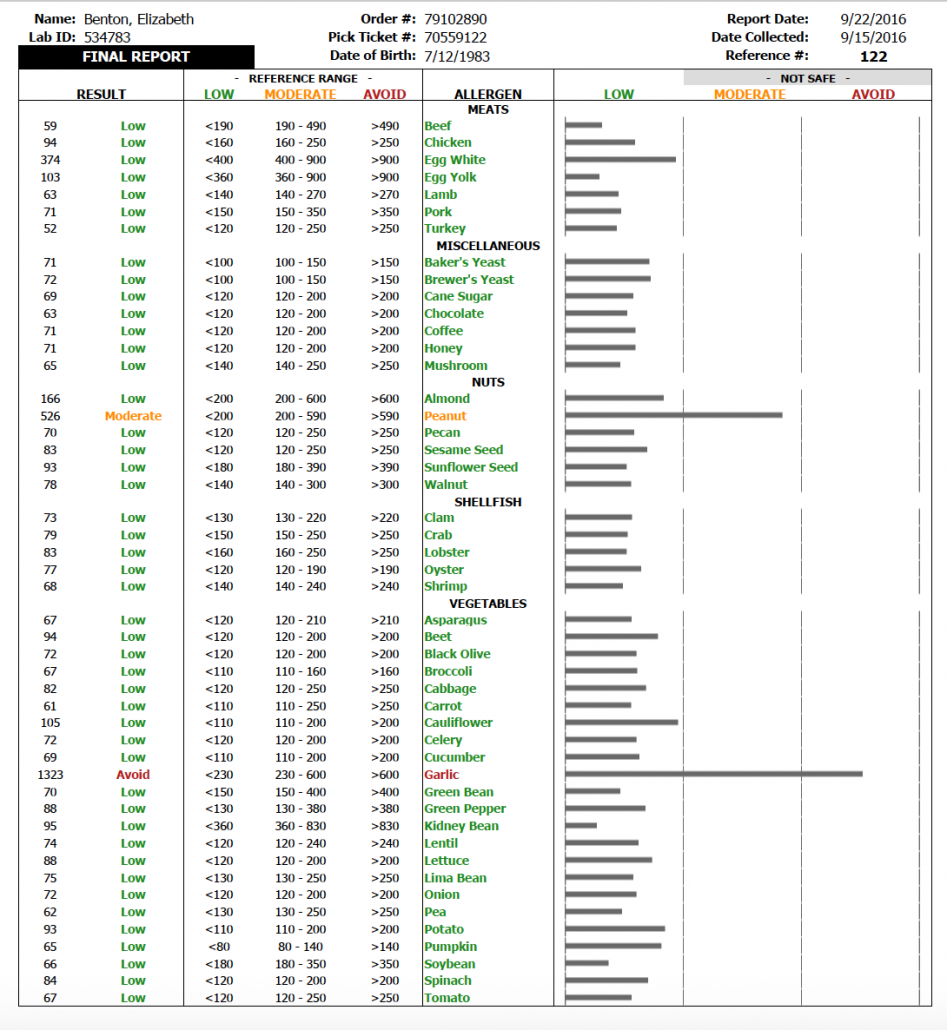
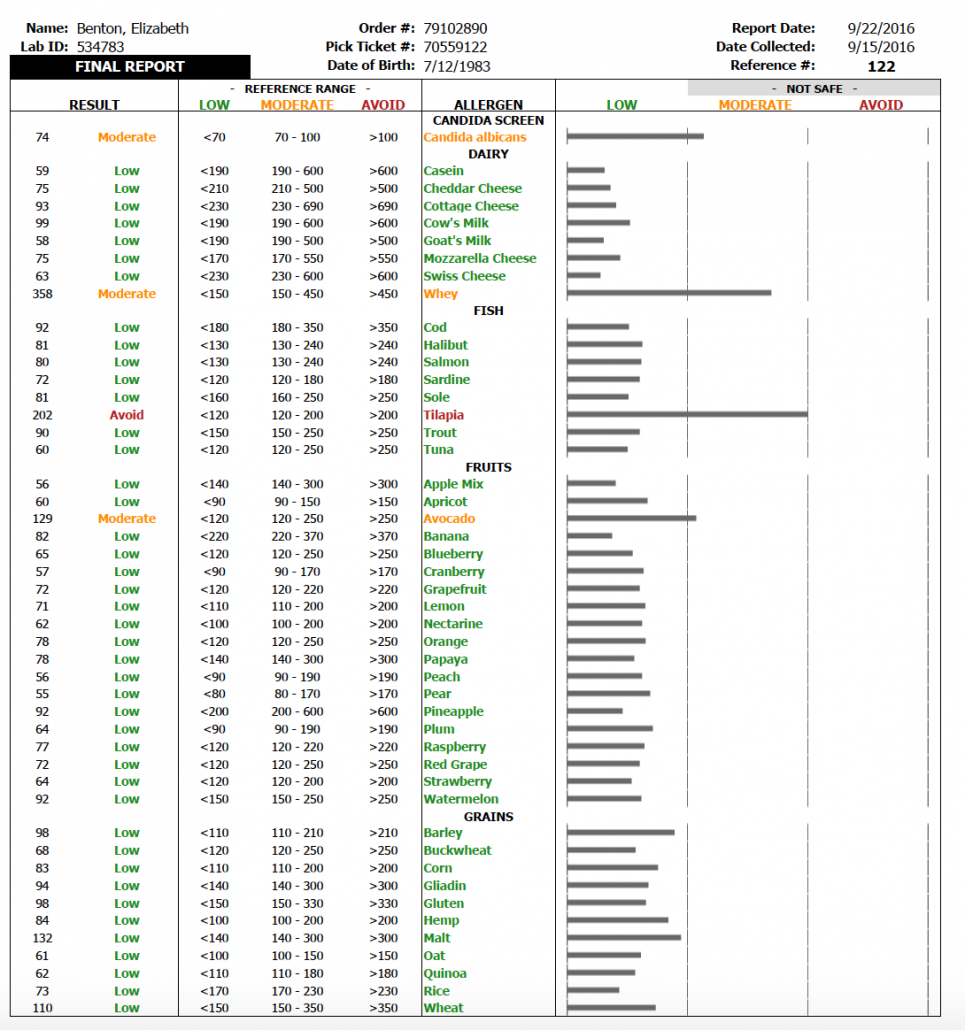
I found that I am highly sensitive to garlic & tilapia and moderately sensitive to whey, yeast, avocado and peanuts. Here’s a peak at my results & here’s a link to the test I took.
If you find the Primal Potential podcast help, it would mean the world to me if you’d take a minute to leave a rating & review! That helps show platforms display my podcast to new listeners! Thank you so much for your support! I can’t tell you how valuable it is!
There is a difference between a food allergy and a food intolerance.
You might have unidentified food intolerances that are impacting your health and your progress towards your goals and not even know it!
And, just because you’ve tolerated a food before doesn’t mean you do now.
Plus, you can overcome your food intolerances!
If you continue to consume a food to which you are even mildly intolerant, you are initiating a domino effect of challenges within your body.
In today’s episode I’m talking about the direct connection between food intolerances, your immune system, your fat loss & your health. I’m sharing the impact of genetics, lifestyle and diet on your immune system and what happens when your immune system is compromised.
In part 2, I’ll share common foods that trigger an immune response and might be responsible for your symptoms and how you can strengthen your immune system & eliminate your symptoms.
Don’t miss the full episode! It’s a really important one!
To answer this question, we first need to understand the role of the immune system, as food intolerances are based on your immune system’s response to food.
Your immune system’s primary function is to protect you from toxins, pathogens and other threats.
Because most threats to your health are introduced to your body through your mouth (what we eat, drink or inhale), the majority of your immune system resides in your gastrointestinal tract.
The immune role in the GI tract is to keep out anything and everything that could be dangerous.
Unfortunately, when we knowing or unknowingly consume foods to which we’re even mildly intolerant, we break down the protective barrier within the GI tract and create larger problems.
What are the symptoms of a food intolerance or autoimmune issue?
There are so many possible symptoms but the common ones include:
bloating
gas
diarrhea
constipation
headaches
rashes & other skin conditions
acne
trouble sleeping
low energy
indigestion
allergies
depression
irritability
joint pain
slow healing
When we fail to eliminate these food allergens and other immune irritants, our immune system becomes compromised and attacks things it shouldn’t, including foods and our own body tissues.
This leads to new food allergies or autoimmune diseases like hashimotos thyroiditis, lupus and arthritis.
The most common autoimmune diseases include:
psoriasis
fibromyalgia
lupus
celiac disease
hashimotos thyroiditism
rheumatoid arthritis
In today’s episode I’m talking about how your body’s inflammatory response works, what happens when common foods trigger inflammation and how we can quiet the inflammation throughout the body and eliminate your symptoms.
I’ll also share one of the primary challenges with convention prescription drug treatments for these autoimmune concerns.
In the next episode I’ll be talking about which foods most frequently trigger this immune response and how we can calm our inflammatory response, heal the immune system and eliminate food intolerances. We’ll closely examine foods including:
If you find the Primal Potential podcast help, it would mean the world to me if you’d take a minute to leave a rating & review! That helps show platforms display my podcast to new listeners! Thank you so much for your support! I can’t tell you how valuable it is!
I think we all want to be more productive. We want to be less stressed while making more progress towards our goals.
That can be a tricky thing to balance because we see the pursuit of our goals as demanding that more get done. We see being more productive as getting more done. In both cases, we feel overwhelmed before we even start because we just don’t have enough time to get more done!
However, to be more productive, I don’t think you need to get more done. To make more progress towards your goals, I don’t think you need to get more done.
In today’s episode I’ll talk about how you can be more productive without doing more and while accelerating your progress towards your goals!
While many of these strategies might seem like common sense, I don’t want you to discount them on those grounds. Instead, ask yourself, “Am I consistently implementing this?”
Knowing the strategy or being familiar with a concept doesn’t matter. Do you live it? Is it yours? Do you have room for improvement? Is it a habit for you?
Don’t reject the obvious – implement it. If you want to be more productive, it’s not about what you know, it’s about what you do and what you do consistently!
Start
Interupt your perseverating on the plan and the overwhelm and take 5 minutes of action in the direction of your goal. Train yourself to leap into action. As I shared from one of my FLFT clients, “action is your pressure release valve!”
Change your language
Work towards no longer thinking or saying things like “I’m so busy/stressed/overwhelmed”. We share these statements like a badge of honor and they don’t do anything to help us be more productive. Instead, replace those thoughts and words with things like, “What I will do next is…” and “What I can do is…” or “What I’m working on now is…”
Question everything
Does this item need to be on your list? Does it need to be done? Does it need to be done today? Are you the one who needs to do it?
Check your priorities
The purpose of a task is to move us towards a goal. Unfortunately, I think we get into a routine of being busy, without ever questioning if the tasks we’re doing have anything to do with the goals we have. So, review your tasks and make yourself identify what goal, if any, that task moves you towards. Is that goal important? Is there a goal?
Stop rushing
Catch yourself when you’re rushing through one task to get to the next. Catch yourself when you’re thinking about what’s next instead of focusing on what you’re doing now. By slowing down, we often go faster and create efficiency.
Be honest about your distractions
If you want to be more productive, look at what is getting in the way of your productivity. What are your most common distractions? Put them on paper and then ask & answer the question, “what can I do to minimize this distraction today?”
Set a timer
Build your focus endurance. Start small, with just 5 minutes of focused effort. Most of us have very limited endurance when it comes to focus. Create it and build upon it.
Stop working
Don’t go from dawn to dusk without dedicated “rest” time. If your rest time includes folding socks or returning emails, you’ll have an over-inflated sense of the time you spent working and you won’t ever feel recovered or rested. Even if it’s 15-20 minutes per day, implement focused rest time.
Establish a routine
Routines create efficiency and efficiency increases productivity. It doesn’t matter if your routine is 3 minutes, 30 minutes, 3 hours or more, work to establish routines to increase your efficiency.
Don’t believe everything you read (or hear)
Don’t blindly implement the strategies of others. Pay attention to what works (and doesn’t) for you and do those things.
If you find the Primal Potential podcast help, it would mean the world to me if you’d take a minute to leave a rating & review! That helps show platforms display my podcast to new listeners! Thank you so much for your support! I can’t tell you how valuable it is!